
Trusting the Herd
Parenting the Passionate in Harrowing Times

The cold does not descend. Instead, it lifts the blanket from the earth, releasing any warmth under the covers and sending a shock across the naked and sleeping land.
Clanking windchimes on the corner of the shed tell me that the wind is coming off the water this morning. It washes the south side of the house with a static trembling, a hollow rushing sound like the inside of a shell. Throughout the night, porch boards smacked, shaking the house with their reverberating, gunshot clatter as they shrank. Decades after they were milled, these boards still beat in the rhythm of winter.
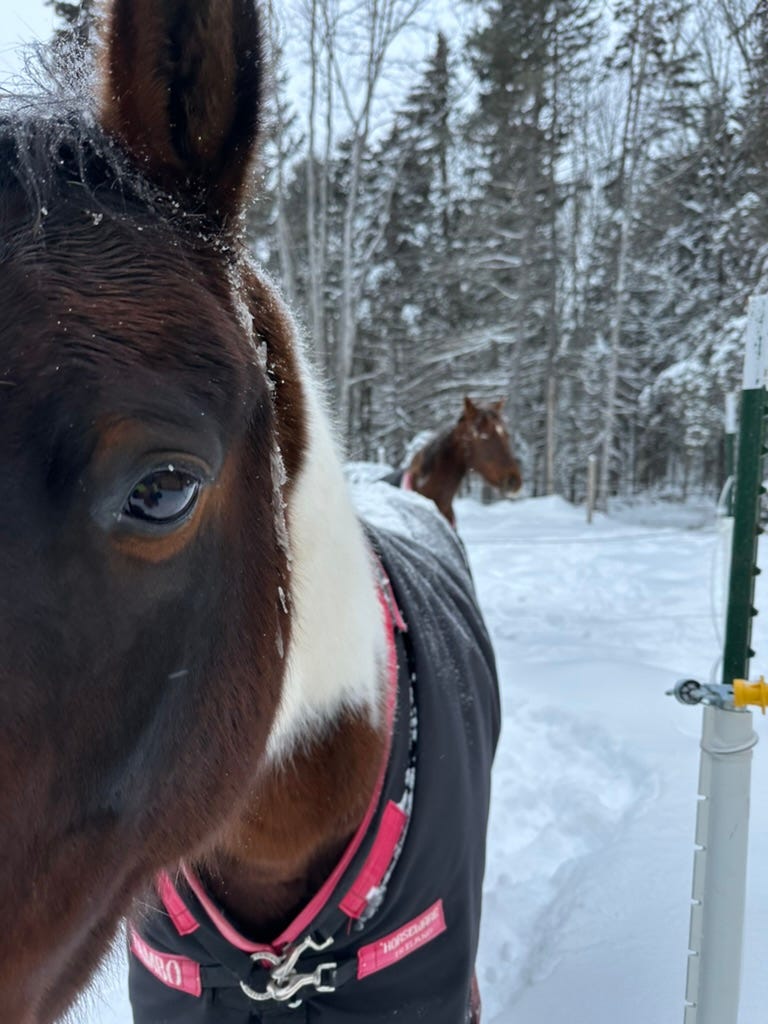
As my home dips into its coldest days of the year, so too goes the nation. The chill comes for Minneapolis. Their circumstances are frightening and they are good at coming together and weathering. People who live in cold places know how to make their own heat.
My family stuffs ourselves into layers and drives to town. I notice the sweet smell of hay wafts from the polyester of my coldsuit, a comfort that softens me like standing next to a horse. We park behind the buildings rebuilt after a fire in 1845, Greek revival in locally-made bricks, windows wide and watching the river. Vela wears her ski goggles and insists that each of us carry a paper plate on which she has drawn pictures of the angry U.S. president and phrases about him being mean. The wind-driven cold cuts through my scarf, pulling tears from my eyes that freeze as they whip across my temples. My eyesockets ache. We walk to the bridge that connects two towns over the Damariscotta River, heads down to protect our breath from the searing chill. The sun is high and bright and only sharpens the cold’s blade.
I have rarely protested before, only in cities, usually with a large group, sometimes chanting, never with my daughter. But Josh and I, each coming to it on our own, have had enough. Only a couple generations separate my Irish, Norwegian and Russian families from those immigrant families who seek safety in Maine today, just like I do. The cruelty and lack of humanity I see on the news nauseates me, even as this treatment is nothing new for the U.S. We are a country founded on brutally removing people from land. But I want more for immigrants just a century behind my families’ moves. I have been thinking often of Ellis Island, where the Statue of Liberty, the Mother of Exiles, holds her torch with these words:
“Keep, ancient lands, your storied pomp!” cries she
With silent lips. “Give me your tired, your poor,
Your huddled masses yearning to breathe free,
The wretched refuse of your teeming shore.
Send these, the homeless, tempest-tost to me,
I lift my lamp beside the golden door!”
It can be hard to know how to hold the light when ensconced in Maine’s white winter. I rarely notice the loneliness of rural living, but I have felt isolated and helpless as migrants, immigrants and citizens are threatened and harmed. One of the primary reasons we stay in Maine is because it feels safe to have our daughter here: she can ride her bike down our road and our neighbors keep an eye on her. Town is quiet, and people come together after storms. We get to choose where we live, and there is work and kindness and safety here. We have plenty of pine, oak, lakes and islands, but few people.
We live far from the city centers where immigrants settle, very far from the tightly knit communities that took us in in Mexico, and still farther from our community that came together from around the world in Berkeley. We wonder if anyone cares in the midcoast. But the dissonance of what we see on the news and what we see out our window become irreconcilable. I want to stand up for the safety and rights of immigrants and citizens but also those who have not had our luck to be born here, who now seek the security I experience in Maine. I chase down ideas about fairness.
I often get hung up on what is fair. I think about the privileges of birth, circumstances, timing, and want to use my dumb luck to lift someone else up. But then there is the other withering side of fairness: tit for tat. I wish I did not have this in me, but I drop the contexts that do not suit me in my own affairs. It is not fair, I say, that I carry most of the burden of daily domestic chores, festering in the bitterness of needing clean counters to be able to think. So when the Portland Press Herald runs an article about ICE supporters in Maine, at first I bemoan their perspectives: it is not fair for people to cut the line, they say. One supporter says his family had challenging years going through immigration paperwork, it is not fair if others don’t. I seethe at the lack of context. But my own insistence on fairness nags me, sliding somewhere on this spectrum. These narrow definitions and tit for tat unravel everything from marriage to country. As they say, resentment is drinking the poison and hoping your enemy dies. I lift that cup to my lips all the time.
I hold this dissonance as we walk to a bridge between two tiny towns and stand on it, our back to the painted metal rail that keeps us from toppling into the black water. When we arrive, I am pleased to find at least forty people standing who share my anger, my sadness, my desire for justice. Solidarity lifts the weight off my heart a little.
But I quickly realize there are so many more! Nearly every car that passes over the bridge honks or waves. People lean their foreheads towards their windshields, eyes wide and shining, shaking their thumbs up as if they were raising their hands in prayer. The cathedral of the car, connecting us all for a moment, a breath of recognition. Some people lean on the horn for the length of the bridge and Vela and I laugh in delight. I can’t believe it. In our little rural community, almost everyone shouts, waves, cheers as they go by. Most are vehement in their movement–I am with you.
Not all cheer. Some avert their eyes as they drive by. Only one person flips us the bird, a scowling man with a gaunt face and jutting chin who makes no eye contact. At first anger boils in my chest. But bitterness is its own curse, and I hope for more for him. Life and narrative make shapes of us, and it is only by privilege that I get to examine my own.
I wave and smile beneath my scarf and peer into cars and see the brightness in people. Vela holds her paper plate in her mittened hand, resolute, demanding that Josh and I hold our plates higher. We have our backs to the wind and I forget to be cold.
We arrived late, so we stay on the bridge as many leave, the regulars nodding to each other, mumbling “see you next week” as if clocking out on Friday. Most of these folks have a couple decades on us; they know the work is never done. People who pass us turn their whole bodies, stiff from cold and age, to thank us for coming. A woman with ruddy cheeks in a green coat thanks us more than once. She locks onto my eyes with the seriousness of someone delivering important news. Bundled people shuffle down the main street sidewalks, the cars rumble by, and the frigid tidal water rushes under us, but this woman has a captivating stillness. Her gaze on me is quiet. “My parents used to bring me to demonstrations. Thank you for bringing your daughter.” I smile and nod as I see her affection for those days flicker across her rosy cheeks.
Does a protest on a bridge that connects two towns on a rural coast matter? As I have learned with many questions like this, the question really is, matters to whom? It matters that the people in this town, scattered across the woods and lands, see that others care enough to stand in subzero temperatures with our children and say this is not right. It matters to the other people on the bridge. It matters to me; I am buoyed. And I don’t often know what matters to Vela beyond the love of her parents, but perhaps someday, these times together will shape her just like Muscongus Sound or the mother tree we hug in our woods or the horses that stand outside her bedroom window, nurturing her empathy, blowing on the ember of her heart for the rest of her life.
A week later, we return to the bridge, this time without Josh, who is sick, and with our chosen family friend Alicia. The day is warmer, the sun bright and high. Alicia drapes her arm over Vela’s shoulder, and we slow as we approach the bridge. There are hundreds of people on the sidewalks, spilling out around the edges, flags and signs stirring the sky. Shouts and the thump of a drum echo through the dry air.
We join a loose clump of people at the edge of a parking lot. Vela insists on chanting. Soon, she has taken the “ICE out!” chant and added a “Trump out!” People across the street from us who were not chanting join in. In this bundled eight year old, I feel that rush of otherworldly energy, so powerful and potent that it envelops the bridge and carries us like seeds on the wind.
But as her mother, I chant with hesitation. Everything is heightened. I feel darkness at the edges of the light. This week feels less safe. It is not the people around me, who are kind and join Vela, lifting their voices. It is the people who do not cheer in their cars. They are angrier. One woman speeds up and roars past us, and I become aware of the lack of a curb where we stand. The tide tears out to sea underneath us. A buzzy uneasiness settles around my shoulders.
We were late again, and Vela wants to be the last to leave. As people filter away, the same woman in the green coat gives Vela a cardboard sign with twine to hang around her neck and says she is staying until Vela leaves. Her unanimity comforts me as we turn to face the traffic together. An older couple built like reeds crosses the bridge and say they are sorry to miss the rally. I watch the corner of the woman’s eyes shine as she leans toward Vela to tell her she is proud of her. I then realize that the only others who remain are counterprotesters, four men in thin cotton American flag pants with large Trump flags and speakers. Vela peers around me and the woman in green to stare at the men. She takes the sign around her neck in her mittened hands and raises her voice.
“TRUMP OUT! ICE OUT! TRUMP OUT! ICE OUT!” Her jaw juts from under the sunglasses she borrowed from Alicia. Vela’s voice goes gritty, her chant quickens, and the tall woman raises her fist, the tendons in her slender wrist flexing. Her voice falls over the road like a felled tree, the sound shaking the bitter air. “TRUMP OUT! ICE OUT!”
Vela sweeps us in. Drivers delight, opening their windows and cheering with her. Injustices that Vela hasn’t even learned about possess her, and she screams into the cold.
One of the Trump men is suddenly in front of us with his phone, filming us, or acting like he is. He snarls a condescending smirk. My blood thunders in my ears, and I look beyond him, fist and chin raised, and keep my smile, keep chanting, keeping my chest half a pace in front of Vela but letting her be. He does not lower his phone to Vela’s height, but pans over us, leaning his device and hand into our space. I size him up: he is small, shorter than me. I think about ICE agents being filmed, about the training a person would need to not find this unnerving. He threatens us with his taunting presence and leering smile, raising the hair on my neck. He has learned from one of the most accomplished bullies in recent history. I am no stranger to threatening men, and instinct kicks in: shoulders straight, look relaxed, keep going.
Vela, like her mother and grandfather before her, hates bullies in a primal way. She leans forward, boring a stare into him, her whole body springing and settling with each word, catalytic and sparkling. Her voice grows hoarse as her body roars. She is a wolf, safe in her pack, howling across the canyons of time, standing up for children of the past and the future. Vela is typically an observer, often leery of danger, cautious as she moves through the world of humans and horses. But here she unleashes a leadership that takes me aback. I neither oppress her nor protect her. Uncertainty fills my body like a dark pit. The women around her chant louder, grinning.
“Child abuse,” the man says, shaking his head. The women jeer and protest that one, but he has already turned and walked away. My muscles stay coiled around my bones. I could probably lift a Volkswagen Beetle with my adrenaline. Our chanting follows him down the bridge. A few minutes later, they pack up their flags. We are the only people left on the bridge. For all their intimidation, their noise, their fancy pants, they could not outlast this eight year old girl.
In between chants, the tall woman tells Vela that they are going to India to see her daughter’s family next week: her granddaughters, who are dark skinned, are too afraid to travel to the U.S. “Can I give you a hug?” she asks Vela, and Vela leaps into her arms. Chosen family comes in all forms.
I wish I could tell you I walked away triumphant. But fear nagged me for the rest of the day. Taking a stand means taking on vulnerability, and I don’t know what the balance is for a daughter’s passion and safety as social norms erode. When does performance become substance? What kind of an adult taunts a girl? I think of the research on war crimes. When men were asked how they could harm and kill children, they answered that their captors were less than human. Just because I see the humanity in a man forcing his phone in my face does not mean he sees mine.
I think about the many people have walked across bridges in the face of oppression and taunting. Ruby Bridges, not just a video but a real child, had to endure the hatred of men as she crossed the threshold to her school day after day. Right now, children just like Vela sit in immigration holding facilities–jails. Vela and I are just two pinpricks of light in a swirling galaxy of stars, holding out against the bottomless darkness. The nervous twins of fear and hope hold court in my chest.
When I don’t know what to do, I come back to the horses. For the first time since we brought them home, fear tinges my preparations to feed them at night. I take our dog Frodo with me across the yard and out the gate. The moon is so bright that I almost laugh out loud at my fear. All the same, Frodo is happy to prance along beside me, sleek black muscle against the blue snow.
It is later than I normally come out at night. Kira is lying down and Maui stands near her, unmoving, ears relaxed. Safety in the herd. When I bring their hay bags, they are slow and sleepy. I reach the back of my hand to each, and they touch my glove with their soft muzzles. They have taken to only sleeping outside on these single digit nights, snow stuck to their cheeks when I feed them in the morning. Horses live in a world of vigilance, but in each other’s company, they can rest. I smile at Maui’s drooping eyelids, call to Frodo, and walk over the squeaky snow in the moonlight, ready to curl up on this winter’s night with my brave herd.
Wow, Jess, just wow. What a powerful piece.
Powerful piece on balancing courage and vulnerability. The moment where Vela transforms from cautious observer to fierce advocate captures something essential about kids needing to se their parents take stands. I've found myself wrestling with that same tension lately between protecting kids from harsh realities and modeling activeparticipation, and this really clarified it for me.